

Connected Logistics Market to Hit USD 114.7Billion by 2036, Led by Asia Pacific with IBM, Cisco & SAP Driving Innovation
Connected Logistics Market
Connected logistics market to reach USD 114.7B by 2036, driven by IoT, AI, 5G, and real-time visibility transforming global supply chain efficiency.
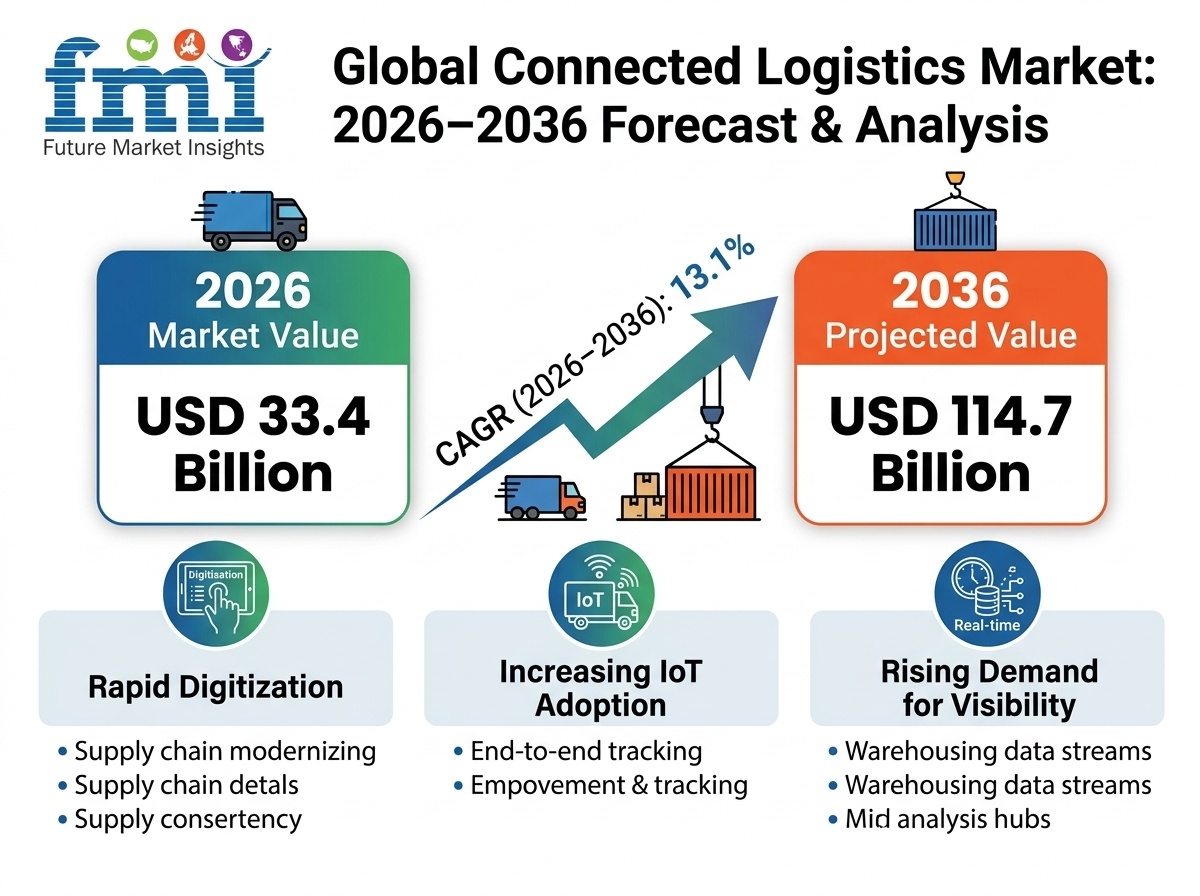
NEWARK, DE, UNITED STATES, April 3, 2026 /EINPresswire.com/ -- The global Connected Logistics Market is valued at USD 33.4 billion in 2026 and is projected to reach USD 114.7 billion by 2036, expanding at a CAGR of 13.1% during the forecast period. Growth is driven by rapid digitization across supply chains, increasing adoption of IoT-enabled tracking systems, and rising demand for real-time data visibility across transport and warehousing operations.
As logistics ecosystems evolve toward automation and intelligence, connected logistics is transforming from basic tracking systems into integrated platforms that enable predictive decision-making, operational efficiency, and enhanced service performance. The integration of AI analytics, edge computing, and 5G connectivity is positioning connected logistics as a strategic pillar in modern supply chain management.
🔗 Request Sample Report | Customize Report | Purchase Full Report
https://www.futuremarketinsights.com/reports/sample/rep-gb-4287
Connected Logistics Market Snapshot (2026–2036)
• Market size in 2026: USD 33.4 billion
• Market size in 2036: USD 114.7 billion
• CAGR (2026–2036): ~13.1%
• Leading component: Connected logistics devices (39.8%)
• Dominant transport mode: Roadways (46.2%)
• Fastest-growing vertical: Healthcare logistics
• Key growth regions: Asia Pacific, North America, Europe
• Key companies: IBM, Cisco Systems, SAP, Microsoft, Oracle
Market Momentum
The connected logistics market begins at USD 33.4 billion in 2026, supported by strong demand for real-time shipment tracking and digital supply chain visibility. Between 2027 and 2030, rapid deployment of IoT sensors, telematics, and GPS-based tracking systems accelerates adoption across transportation networks and warehouse operations.
Entering 2032 and beyond, the market witnesses a shift toward predictive and prescriptive logistics systems powered by AI and machine learning. The expansion of 5G-enabled logistics corridors and edge computing infrastructure further enhances real-time decision-making capabilities. By 2036, the market reaches USD 114.7 billion, driven by widespread adoption across e-commerce, healthcare, manufacturing, and automotive logistics.
Why the Market is Growing
The Connected Logistics Market is expanding rapidly as enterprises prioritize efficiency, transparency, and resilience across supply chains. Real-time visibility platforms enable logistics providers to monitor shipments, optimize routes, and respond proactively to disruptions.
IoT-enabled devices and sensors play a critical role in capturing real-time data across transportation and storage environments. These technologies allow businesses to improve shipment integrity, reduce delays, and enhance customer satisfaction.
Additionally, the integration of AI-driven analytics is enabling predictive maintenance, intelligent routing, and dynamic scheduling. Logistics providers can now anticipate disruptions, optimize fleet utilization, and reduce operational costs.
Sustainability is another major growth driver, as companies adopt connected solutions to measure emissions, reduce fuel consumption, and optimize energy usage across logistics networks. The shift toward greener supply chains is further accelerating technology adoption.
Segment Spotlight
1. Component: Connected Logistics Devices Lead
Connected logistics devices account for approximately 39.8% of the market, driven by widespread deployment of IoT sensors and real-time monitoring systems. These devices provide continuous operational intelligence, making them essential for modern logistics operations.
2. Transportation Mode: Roadways Dominate
Roadway logistics holds around 46.2% share, supported by its flexibility and efficiency in last-mile delivery and regional distribution. Advanced telematics and routing technologies are enhancing performance across road transport networks.
3. Vertical: Healthcare Emerges as High-Growth Segment
Healthcare logistics is witnessing the fastest growth, driven by stringent regulatory requirements and the need for temperature-controlled supply chains. Real-time monitoring ensures compliance and product safety in pharmaceutical distribution.
Drivers, Opportunities, Trends, Challenges
• Drivers: Supply chain digitization, IoT adoption, demand for real-time visibility
• Opportunities: AI-driven logistics, autonomous delivery systems, smart infrastructure
• Trends: Shift toward predictive analytics, edge computing, 5G-enabled logistics
• Challenges: Data security, integration complexity, regulatory compliance requirements
Country Growth Outlook (2026–2036)
Asia Pacific leads the market, driven by rapid e-commerce expansion and infrastructure modernization. China (13.6%) and India (14.1%) emerge as high-growth markets due to strong digital transformation initiatives.
The United States (11.2%) maintains steady growth supported by advanced logistics networks and technology adoption. Germany (12.1%) leads in Europe with Industry 4.0 integration, while the United Kingdom (10.8%) benefits from supply chain modernization and trade adaptation strategies.
Competitive Landscape
The connected logistics market is highly competitive, with global technology leaders and specialized solution providers driving innovation. Companies such as IBM, Cisco Systems, SAP, Microsoft, and Oracle are focusing on AI integration, IoT connectivity, and cloud-based logistics platforms to strengthen their market position.
Competition is increasingly centered on platform integration, real-time analytics capabilities, and scalability. Vendors are investing in advanced technologies such as edge computing, blockchain, and autonomous logistics systems to enhance operational efficiency and customer experience.
Strategic partnerships with logistics providers and transportation companies are becoming critical, enabling seamless integration of connected solutions into real-world operations.
Frequently Asked Questions (FAQ)
What is the global Connected Logistics Market size?
The market is valued at USD 33.4 billion in 2026 and is projected to reach USD 114.7 billion by 2036.
At what rate is the market expected to grow?
The market is forecast to expand at a CAGR of 13.1% from 2026 to 2036.
What is connected logistics?
Connected logistics refers to the use of IoT, AI, and real-time data platforms to monitor, manage, and optimize supply chain operations.
Why is connected logistics gaining popularity?
It enhances visibility, improves efficiency, reduces costs, and enables real-time decision-making across logistics networks.
Explore More Related Studies by FMI
• Automotive Sensor Market
https://www.futuremarketinsights.com/reports/automotive-sensor-market
• Industrial Automation Software Market
https://www.futuremarketinsights.com/reports/industrial-automation-software-market
• IoT Connectivity Market
https://www.futuremarketinsights.com/reports/iot-connectivity-market
About Future Market Insights (FMI)
Future Market Insights, Inc. (FMI) is an ESOMAR-certified, ISO 9001:2015 market research and consulting organization, trusted by Fortune 500 companies and global enterprises. With a strong global presence, FMI delivers data-driven insights across industries, helping organizations make informed strategic decisions in a rapidly evolving market landscape.
Why Choose FMI:
https://www.futuremarketinsights.com/why-fmi
Sudip Saha
Future Market Insights Inc.
+1 347-918-3531
rahul.singh@futuremarketinsights.com
Legal Disclaimer:
EIN Presswire provides this news content "as is" without warranty of any kind. We do not accept any responsibility or liability for the accuracy, content, images, videos, licenses, completeness, legality, or reliability of the information contained in this article. If you have any complaints or copyright issues related to this article, kindly contact the author above.
